
How to measure a 5 lug trailer axle bolt pattern

How to Measure a 5 Lug Trailer Axle Bolt Pattern 2

A 5-lug trailer wheel bolt pattern is identified by the number of wheel studs and the diameter of the imaginary circle passing through their centers. Because a five-lug hub has no stud directly opposite another, it must be measured differently from a 4-, 6-, or 8-lug pattern.

Quick Answer: How to Measure a 5-Lug Bolt Pattern

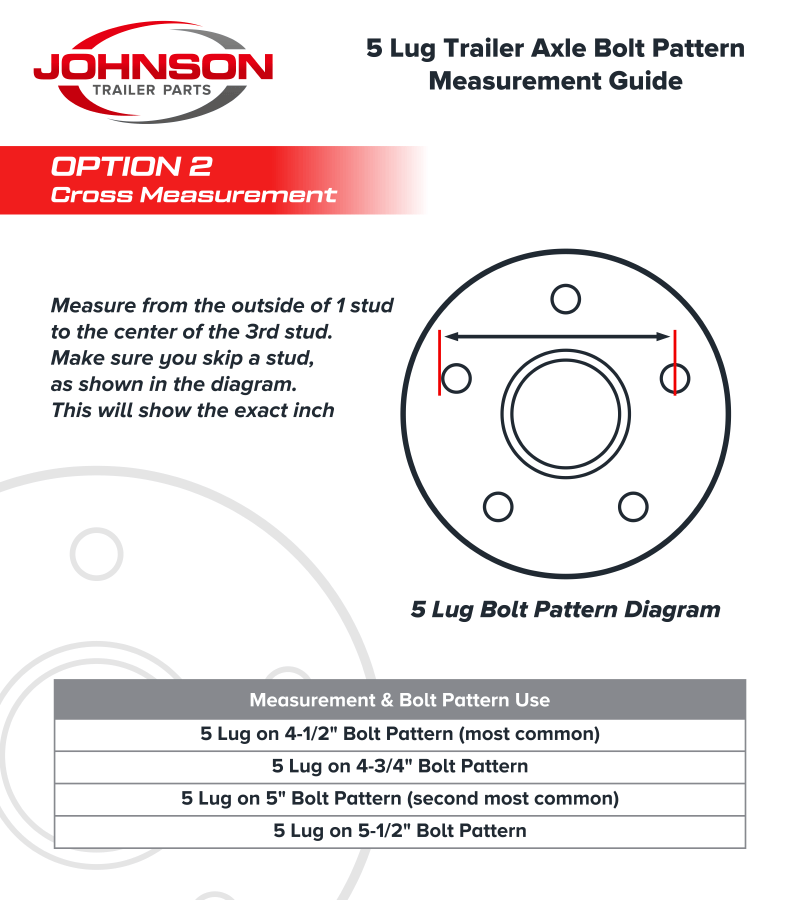
Choose one wheel stud, skip the next stud, and measure to the third stud. Measure from the outside edge of the first stud to the center of the third stud. The result identifies the approximate bolt-circle diameter, such as 5 on 4.5, 5 on 4.75, 5 on 5, or 5 on 5.5.

Measure Before Ordering: All five-lug patterns can look similar. A 5-on-4.5 wheel will not fit a 5-on-5 hub correctly. Never force a wheel over the studs or assume the pattern from the number of lugs alone.

What Does 5 on 4.5 Mean?

A bolt pattern written as 5 on 4.5, 5 x 4.5, or 5-4.5 describes the same arrangement:

  • 5 is the number of wheel studs.
  • 4.5 inches is the diameter of the bolt circle formed by the centers of those studs.

The bolt circle is also called the bolt-circle diameter (BCD) or pitch-circle diameter (PCD). The 5-on-4.5 pattern is the most common five-lug trailer pattern, but it is not the only one.


Method 1: Cross-Stud Measurement

This is the quickest field method and can be used on a hub, brake drum, or mounted wheel when the measurement points are accessible.

  1. Choose any wheel stud as the starting point.
  2. Skip the stud immediately beside it and locate the third stud—the one farthest across the pattern.
  3. Measure from the outside edge of the starting stud to the center of the third stud.
  4. Compare the measurement with the common patterns below.
  5. Repeat the measurement from another starting stud to confirm the result.
5-lug trailer bolt-pattern cross-stud measurement from the outside edge of one stud to the center of the third stud
Measure from the outside edge of one stud to the center of the third stud across the pattern.
Accuracy Tip: Remove decorative wheel covers, clean rust or debris from the studs, keep the tape measure flat across the wheel face, and measure more than once. If the result falls between two patterns, use the adjacent-stud method or a bolt-pattern template before ordering.

Method 2: Measure Between Two Adjacent Stud Centers

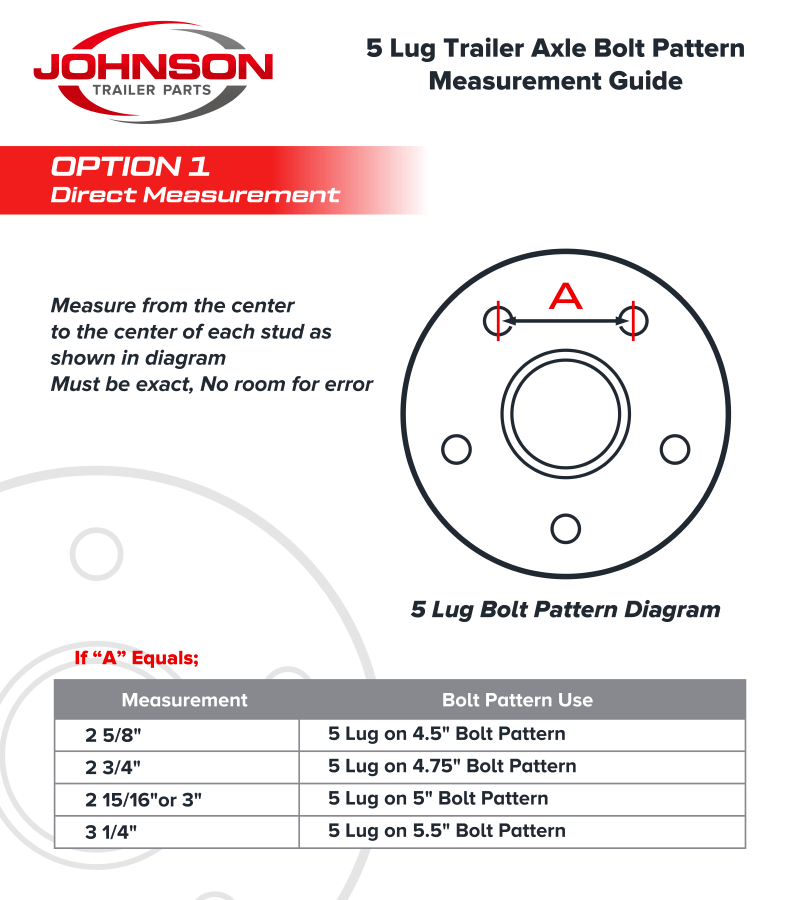
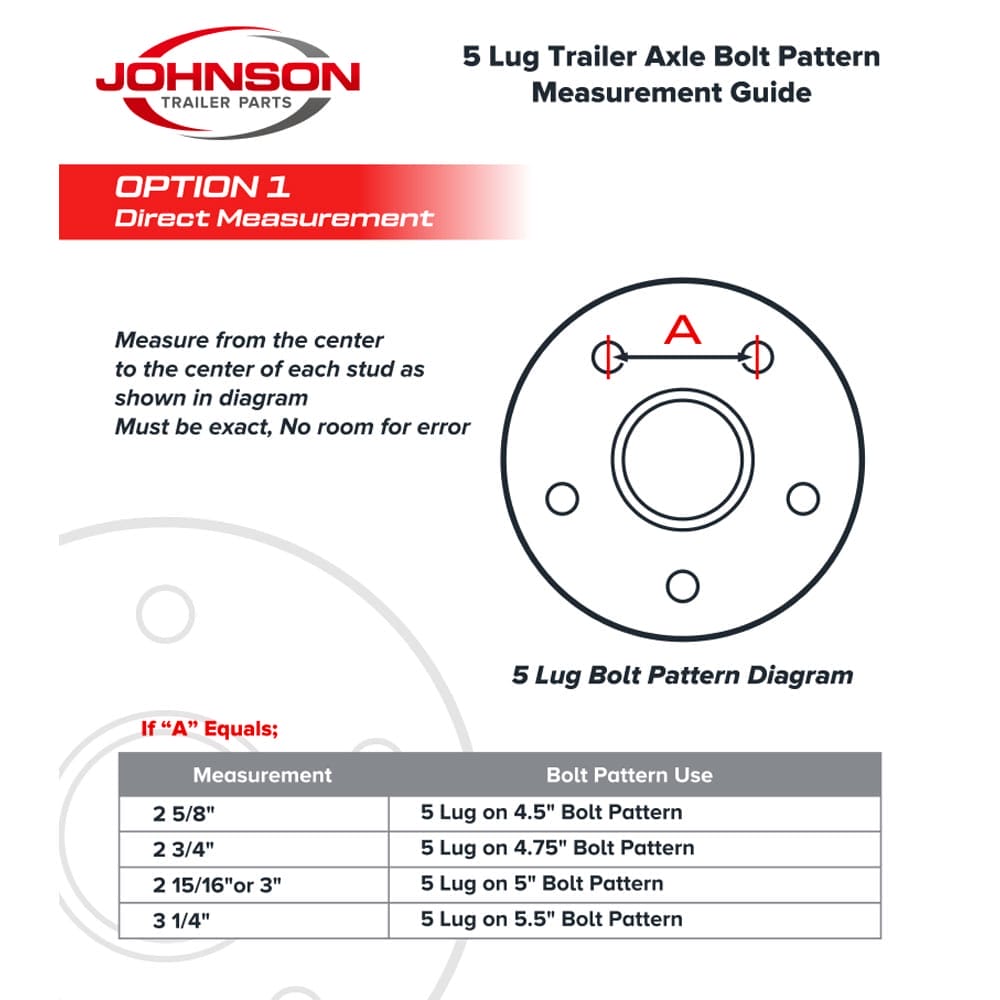
When the cross measurement is difficult to read, measure from the center of one stud to the center of the stud directly beside it. Because this is not the full bolt-circle diameter, compare the measurement with the reference chart below.

5-lug trailer bolt-pattern adjacent-stud measurement taken center-to-center between two neighboring wheel studs
Measure center to center between two neighboring studs, then use the conversion table.

← Swipe left/right to see the full table →

Adjacent Stud Center-to-Center 5-Lug Bolt Pattern
2-5/8 inches 5 on 4.5
2-3/4 inches 5 on 4.75
3 inches 5 on 5
3-1/4 inches 5 on 5.5

Measurement Note: These are practical tape-measure references commonly used to identify trailer bolt patterns. Measure carefully and confirm an uncertain or borderline result with the cross-stud method or a bolt-pattern template before ordering.


Common 5-Lug Trailer Bolt Patterns

The following five-lug patterns are used on trailer hubs and brake drums:

  • 5 on 4.5: The most common five-lug trailer pattern and widely available on light-duty trailer hubs, drums, and wheels.
  • 5 on 4.75: Less common, but available on certain trailer hub and axle configurations.
  • 5 on 5: Used on some trailer hubs, drums, and wheels.
  • 5 on 5.5: A larger five-lug pattern used on some trailer and specialty applications.

Dexter lists all four of these five-lug patterns among its light-duty axle and hub offerings. Review the applicable axle or hub specifications rather than assuming that every five-lug trailer uses 5 on 4.5. See Dexter’s official light-duty axle information.

Bolt Pattern Does Not Determine Axle Capacity: Lug count and bolt-circle diameter identify wheel-to-hub compatibility, not the axle’s weight rating. Use the axle label, serial number, hub face, spring center, tube, spindle, bearings, seal, brakes, and complete wheel-end configuration to identify a replacement axle. See our complete trailer axle measurement guide.

Bolt Pattern Is Only One Part of Wheel Fitment

A matching bolt pattern is required, but it does not guarantee that a wheel is correct for the hub, axle, or trailer. Confirm all of the following before installation:

  • Bolt pattern: Lug count and bolt-circle diameter must match exactly.
  • Stud diameter and thread: Wheel holes, studs, and lug nuts must be compatible.
  • Wheel pilot or center bore: The wheel must clear the hub or grease-cap area and seat fully against the mounting face.
  • Lug-nut seat: The nut seat style must match the wheel design.
  • Wheel offset and width: The mounted tire must clear the frame, body, suspension, brakes, and fender throughout operation.
  • Wheel and tire load ratings: Both must be suitable for the trailer’s rated application.

Can You Change to a 5-on-4.5 Pattern?

Sometimes, but do not select replacement hubs by bolt pattern alone. A replacement hub or drum must match the spindle, inner and outer bearings, seal surface, hub length, brake size when applicable, wheel studs, lubrication system, and axle capacity. The wheels and tires must also provide the correct clearance, offset, and load rating.

If changing the complete axle, record the hub face, spring center, capacity, brake configuration, suspension arrangement, wheel specifications, and all other required dimensions before ordering.


Use a 5-Lug Bolt-Pattern Template

For most customers, a physical bolt-pattern template is the easiest and most repeatable way to identify a five-lug pattern. It removes the need to interpret close fractional measurements or perform a conversion. Place the template over the studs and verify that all five holes align without forcing or angling the tool.

A durable plastic template can be kept in a toolbox and reused whenever you need to check another trailer wheel, hub, or brake drum.

Plastic 5-Lug Bolt-Pattern Template

Quickly identify 5-on-4.5, 5-on-4.75, 5-on-5, and 5-on-5.5 trailer wheel and hub patterns with one durable, reusable tool—no conversion chart or measurement guesswork required.

View the 5-lug bolt-pattern template.

Watch: How to Measure a 5-Lug Trailer Bolt Pattern

See the measurement points and methods demonstrated by Johnson Trailer Parts.


5-Lug Trailer Bolt-Pattern FAQs

How do I measure a 5-lug trailer bolt pattern?

Choose one stud, skip the neighboring stud, and measure to the third stud across the pattern. Measure from the outside edge of the first stud to the center of the third. You can also measure center to center between adjacent studs and use the reference chart in this guide.

What does a 5-on-4.5 bolt pattern mean?

It means the hub or wheel has five studs positioned on an imaginary circle measuring 4.5 inches in diameter. It may also be written as 5 x 4.5 or 5-4.5.

Is 5 on 4.5 the same as 5 x 114.3?

Yes. A 4.5-inch bolt circle equals 114.3 millimeters, so 5 on 4.5 and 5 x 114.3 describe the same five-lug bolt pattern.

What are the common 5-lug trailer bolt patterns?

Common trailer patterns include 5 on 4.5, 5 on 4.75, 5 on 5, and 5 on 5.5. The 5-on-4.5 pattern is the most common, but the four patterns can look similar and are not interchangeable.

Will a 5-on-4.5 wheel fit a 5-on-5 hub?

No. Both have five lugs, but their bolt-circle diameters differ. The wheel will not seat correctly and must not be forced onto the studs.

How far apart are adjacent studs on a 5-on-4.5 pattern?

The practical center-to-center tape-measure reference is approximately 2-5/8 inches. That spacing is used to identify the pattern; the bolt-pattern measurement itself is the 4.5-inch diameter of the imaginary circle passing through all five stud centers.

Are automotive and trailer wheels with the same bolt pattern interchangeable?

Not automatically. The bolt pattern may match while the center bore, offset, wheel width, stud or lug-nut seat, load rating, and tire clearance do not. Verify every fitment and capacity requirement.

Can I determine trailer axle capacity from the bolt pattern?

No. Bolt pattern identifies wheel-to-hub compatibility, not axle capacity. Several axle families can share a bolt pattern. Use the axle label or serial number and verify the complete axle, hub, spindle, bearing, seal, brake, and beam configuration.

Can I change my trailer’s bolt pattern by replacing the hubs?

Only when a compatible replacement hub or drum is available for the existing spindle, bearings, seal, brake system, lubrication system, and axle capacity. Confirm wheel specifications and clearances as well. Do not purchase hubs from bolt pattern alone.

What should I do if my measurement falls between two patterns?

Clean the studs, keep the tape flat, measure from multiple starting points, and verify the measurement with the adjacent-stud reference chart or a bolt-pattern template. Do not round an uncertain measurement and order parts from it.


Need Help Confirming Your Trailer Bolt Pattern?

Johnson Trailer Parts can help identify your wheel pattern and review trailer axle, hub, drum, bearing, seal, brake, wheel, and fitment information before you order.

Call or Text: (602) 292-9690
Email: sales@johnsontrailerparts.com

2 Comments

  1. How can I get one of your lug pattern measuring tools that are plastic. A friend had one at his body shop that would be very handy for me. Thank you

Leave a Reply

Your email address will not be published. Required fields are marked *